The Hidden Cost of Sharing Your Trades Publicly
Sharing your trades publicly can build your credibility. It can also destroy your edge.
The Market Does Not Care About Your Audience
Every trade you take has a random outcome. Your pattern may repeat itself with statistical reliability. But the result of any single trade is unpredictable.
Mark Douglas put it clearly:
“Each individual outcome is unpredictable and unknowable, but over a series of events, the law of probabilities will work its magic.”
This is the foundation of probabilistic thinking. You don’t need to win every trade. You need to execute your edge consistently over a large sample size.
But here’s the problem.
When you share a trade publicly, the outcome stops being just data in your journal. It becomes a statement. People react to it. They judge it. They have opinions about it.
And those opinions can quietly change the way you think about your own trading.
How External Feedback Corrupts Your Process
You post a trade. You explain the setup. You show your entry, your stop, your target.
If the trade works, you get validation. That feels good.
If the trade gets stopped out, something else happens.
Comments start coming in. “That was not a good setup.” “I already took that one, and I lost too.” “Maybe you should try a different approach.”
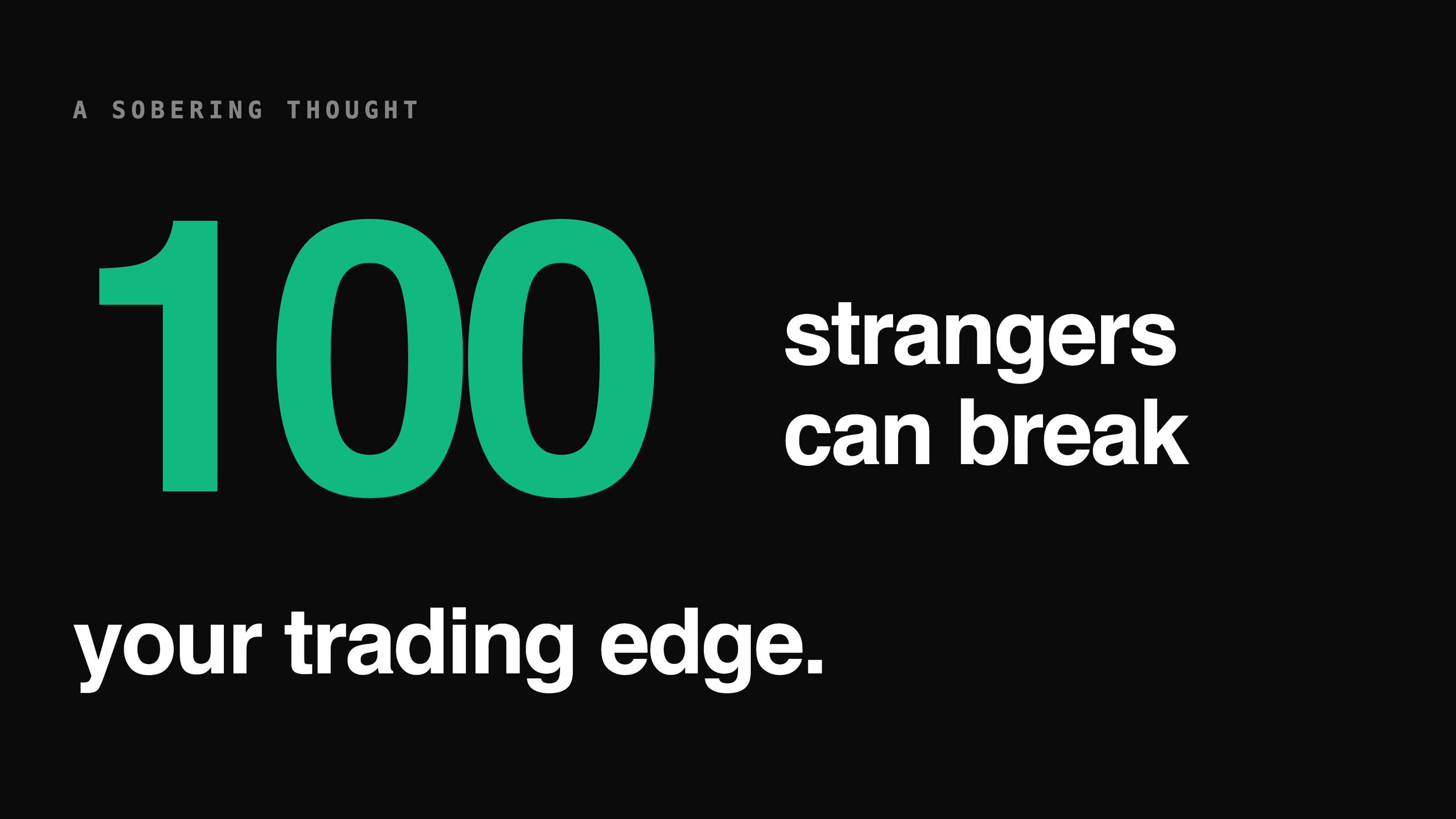
None of these people know your strategy. None of them have seen your backtest data. None of them understand your edge over a series of 100 trades.
But their words still get in.
You start reviewing the trade differently. Not based on whether you followed your rules. Based on how the outcome was perceived.
That is the moment your process starts to break.
The Negativity Loop During Drawdowns
Drawdowns happen. They are not a sign that your strategy is broken.
As Douglas wrote: “The huge drawdowns that traders experience are not the result of something they didn’t know about the market. They are the result of something they didn’t know about themselves.”
Now imagine you’re in a drawdown and sharing every trade publicly.
Loss after loss. Post after post.
Each one attracting sympathy, doubt, or silence.
Over time, a loop forms:
- You post a losing trade
- You receive negative or discouraging feedback
- You start questioning your setup
- You hesitate on the next trade or tweak your rules
- Your data gets corrupted because you stopped following your strategy
- You can no longer tell if the drawdown is random or real
This is the loop. It’s quiet. It builds slowly. And by the time you notice it, the damage is already in your trading journal.
Your journal only works if every trade was executed according to your rules. Once external pressure starts changing your decisions, the data is no longer clean. You can’t tell if the drawdown is your strategy or your emotions.
What I’ve Learned From Sharing Publicly
I share all my trades. Every entry, every exit. Wins and losses. That transparency is part of what Trader Gu is built on.
But I’ve learned something important along the way.
I don’t post detailed breakdowns of all my losing trades. Not because I’m hiding them. All my trades and P&L are available on my public trading dashboard.
I don’t post them because the negativity loop is real. I’ve felt it.
There were periods where a string of losses made me question setups that were perfectly valid. Not because of my own analysis. Because of how the losses felt when they were public.
I had to step back and remind myself: the market is random on a trade-by-trade basis. A losing streak does not mean the strategy is broken. It means probabilities are doing what probabilities do.
I wrote about this in my survivorship bias post. Not every loss is feedback. Some losses are simply the cost of trading a system in a random market.
Be Deliberate About What You Share
This post is not about telling you not to share your trades. It’s about being honest with yourself about how sharing affects your psychology.
If you choose to share publicly, ask yourself:
- Am I sharing this to document my process, or to seek validation?
- Can I handle negative feedback on a losing trade without it affecting my next decision?
- Am I strong enough psychologically to keep following my rules during a public drawdown?
If the answer to any of those is “not yet,” protect yourself. Share your winners. Share your process. Share your thinking. But maybe keep the detailed loss reviews in your private journal until your psychology can handle the exposure.
Trading psychology is one of the pillars of consistent, profitable trading. It’s something I work on daily.
“By accepting the randomness of these outcomes, they can produce consistent results.” — Mark Douglas
If sharing helps you stay disciplined, share. If it doesn’t, step back.
Your edge is more important than your audience.
From the course
Module 9 — Trading Psychology
Trading psychology and discipline. Learn process over outcome, how to deal with losses, and build the mental resilience that separates profitable traders from the rest.
Start the module →